

What Affects Deep Hole Drilling Accuracy? From BTA Drilling to Machine Selection
Why Deep Hole Accuracy Is So Hard to Control
In machining practice, a hole is considered a deep hole once its length-to-diameter ratio (L/D) exceeds 5. Beyond that point, the rules of ordinary drilling stop applying: the drill tube becomes long and slender, the cutting zone is sealed inside the workpiece where nobody can see it, chips must travel through up to a meter of bore before escaping, and coolant has to be forced in under high pressure just to reach the cutting edge.
That is why the same machine that holds IT8 tolerance on a 100 mm shallow hole can produce taper, deviation and chatter marks all at once on a 100 mm × 2000 mm deep hole. Deep hole accuracy is not saved by an operator's feel — it is a system outcome determined by the machine, the tool, the coolant, the workpiece material and the cutting parameters. If any one link fails, the error gets amplified along the hole depth.
First, Agree on What "Accuracy" Means
Before comparing machines, define what is being measured. Deep hole drawings usually specify four different things, and each has its own error sources:
- Bore diameter (IT grade) — IT8–IT10 as drilled, IT6–IT7 after honing. Main error sources: drill and guide pad wear, coolant pressure fluctuation.
- Roundness and cylindricity — 0.02–0.05 mm. Main error sources: tool tube vibration, unstable pad support, inhomogeneous material.
- Axis straightness / deviation — 0.1–0.5 mm per 1000 mm. Main error sources: guide bush misalignment, asymmetric cutting edges, hard and soft spots in the material.
- Surface roughness Ra — 3.2 µm as drilled, 0.2–0.4 µm after honing. Main error sources: built-up edge, chip scratching, chip-breaking condition.
A fact often missed in purchasing discussions: honing dramatically improves form accuracy — roundness, cylindricity and surface finish — but it is a self-referencing process. The honing head follows the existing bore. It cannot correct the position of the hole axis or its alignment to datums. If drilling leaves the hole 1 mm off-center, honing will not bring it back. Accuracy has to be controlled from the drilling stage onward.
Six Factors That Determine Deep Hole Drilling Accuracy
1. Machine rigidity, spindle and guide bush alignment
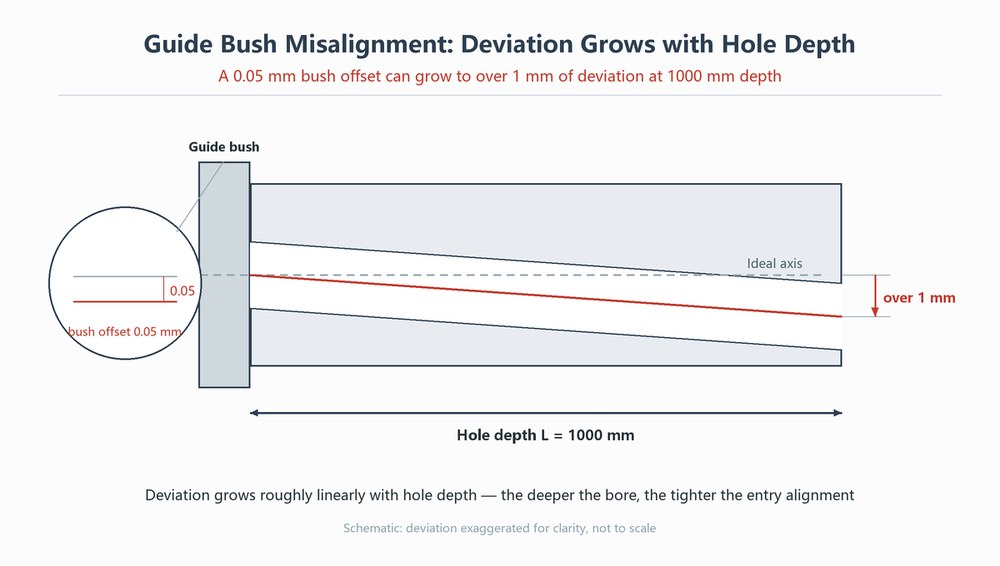
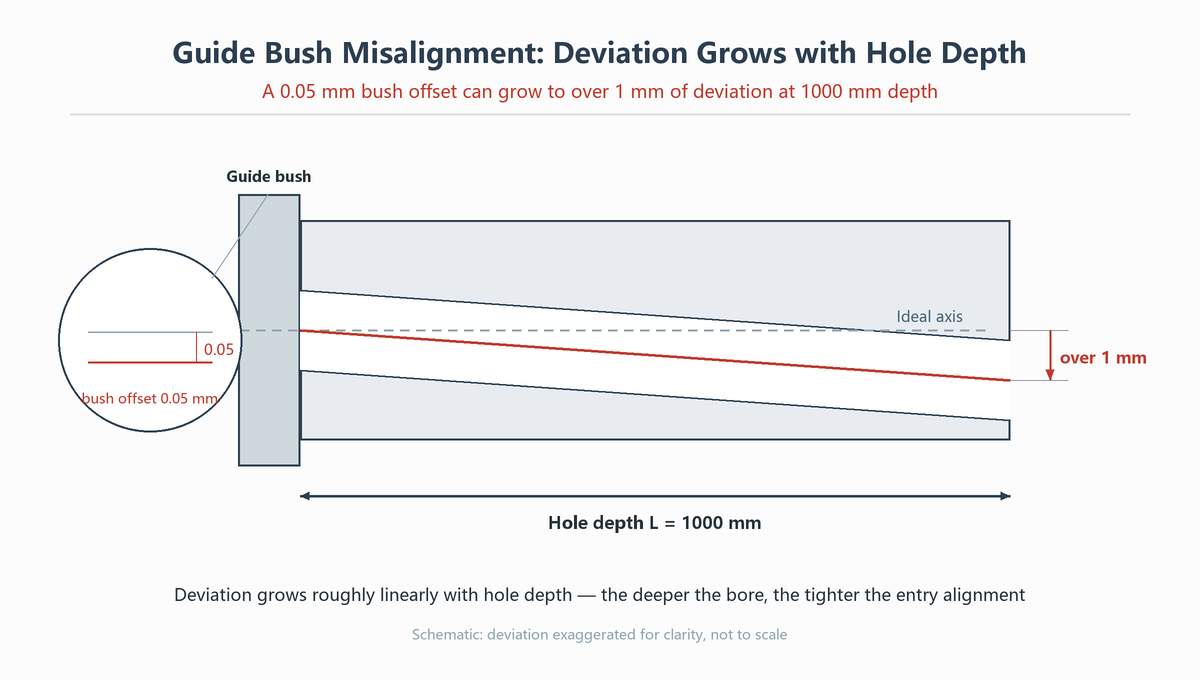
The highest-weight factor of all. The most sensitive single item is the coaxiality between the guide bush, the work spindle and the drill tube spindle. A widely used rule-of-thumb calculation: with a 50 mm long guide bush, an offset of just 0.05 mm between the bush axis and the work spindle axis can grow into more than 1 mm of hole deviation at 1000 mm depth. Deviation increases roughly linearly with hole depth, so the deeper the bore, the harsher the requirement on entry alignment.
Beyond coaxiality, check spindle radial runout, full-stroke guideway straightness, backlash and crawl in the feed system, and whether the machine bed has been properly stress-relieved.
2. Tooling: BTA drill geometry, guide pads and wear
A BTA deep hole drill balances cutting forces across three edges — outer, intermediate and center — while guide pads riding on the bore wall provide support and burnish the surface. Three things go wrong most often:
- Asymmetric cutting edges. Unequal edge angles or uneven wear leave a net radial force, and the drill walks steadily to one side. Inspect edge symmetry under a tool microscope after every regrind.
- Guide pad wear. Pads are consumables. Once worn, support is lost and the bore shrinks or tapers. A part worth a few dollars decides the straightness of a bore several hundred millimeters long — enforce a replacement interval.
- Chip breaker geometry. The chip breaker dictates chip form. Chips must come out short and C-shaped; long stringy chips will clog the drill tube.
3. Coolant: pressure, flow, filtration and temperature
In deep hole machining the coolant cools, lubricates and — critically — is the only force that carries chips out of the hole. Match pressure and flow to hole diameter; smaller and deeper holes need higher pressure. Filtration is where most shops slip: recirculated fine chips scratch the finished wall and push Ra up, so filter to 20 µm or better. And stabilize oil temperature within ±2 °C — thermal drift on long parts shows up directly as inconsistent bore size.
4. Workpiece material and preparation
The drill drifts toward the softer side of the material. Band segregation, inclusions, porosity and asymmetric forging flow all cause sudden cutting-force changes — a hidden root cause of axis deviation. For tight straightness requirements, normalize or harden-and-temper before drilling to refine and homogenize the structure and relieve residual stress. Also machine an entry pilot and a locating spigot on the drilling end, plus an alignment band on the far end: these two references set the quality of the initial self-centering.
5. Cutting parameters and machining configuration
Of the three cutting data, feed rate is the most sensitive to deviation — excessive feed raises axial force, bends the drill tube, and chasing cycle time with a heavy feed is a classic mistake. Three configurations exist: workpiece rotating with the tool feeding only (best self-centering; ideal for cylinders, spindles and other rotationally symmetric parts); tool rotating and feeding with a fixed workpiece (for non-round or oversized parts, demands more from the spindle); and counter-rotation of both workpiece and tool (self-centering effect for high-accuracy work).
6. Chip evacuation and process monitoring
Nobody can watch the cutting zone, so the process is judged by sound, chip shape, vibration and the pressure gauge. A sudden rise in oil pressure is the classic warning of chip packing — keep pushing and the next event is a broken drill buried inside the workpiece, the most expensive failure mode in deep hole machining. Add coolant pressure/flow and spindle power monitoring so judgment moves from experience to thresholds and alarms.
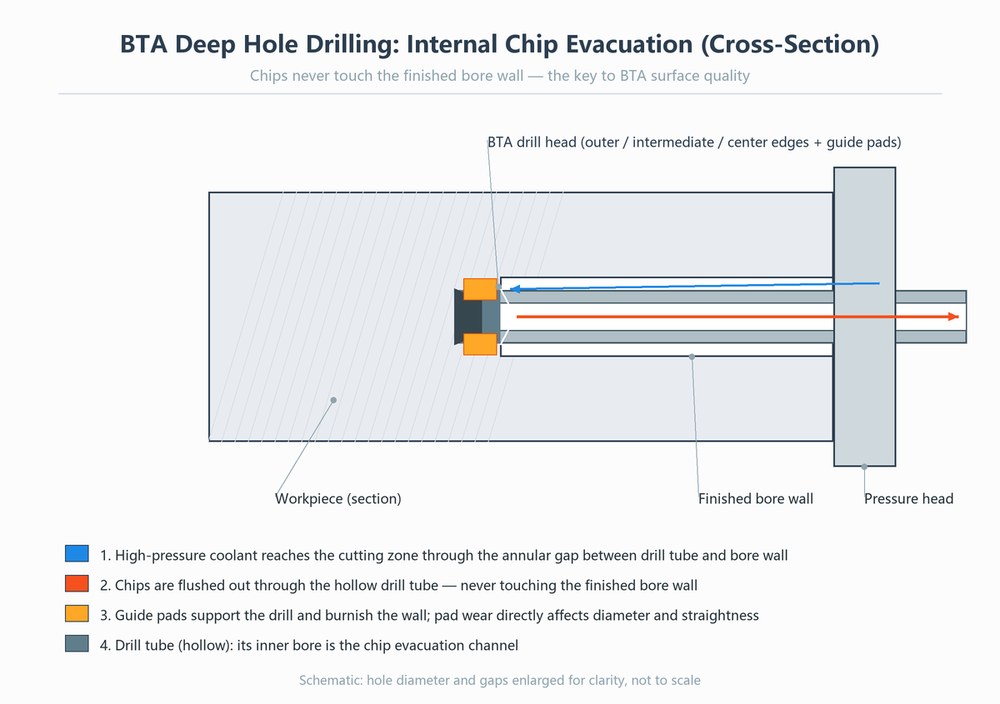
Four Deep Hole Drilling Methods Compared
Method choice is the starting point of machine selection. Figures below follow common industry references; actual values vary with machine condition, tool brand and material:
Gun drilling (external chip evacuation)
- Hole diameter range: φ2–20 mm
- Max L/D ratio: 100 and beyond
- Achievable tolerance: IT8–IT10
- Surface finish: Ra 1.6–3.2 µm
- Relative productivity: low
- Machine requirement: very high coolant pressure and filtration
- Typical applications: small precision bores, mold cooling channels, medical devices
BTA drilling (internal chip evacuation)
- Hole diameter range: φ6–60 mm
- Max L/D ratio: 100 and beyond
- Achievable tolerance: IT7–IT9
- Surface finish: Ra around 3.2 µm
- Relative productivity: 3× gun drilling or more
- Machine requirement: dedicated pressure head and sealing
- Typical applications: cylinder tubes, hydraulic props, spindle center bores
Ejector drilling (internal, double tube)
- Hole diameter range: φ16–65 mm
- Max L/D ratio: up to 100
- Achievable tolerance: IT10–IT11
- Surface finish: Ra 3.2–6.3 µm
- Relative productivity: medium-high
- Machine requirement: low sealing demand — runs on lathes and machining centers
- Typical applications: retrofit jobs without a dedicated deep hole machine
DF system (double-feed internal)
- Hole diameter range: φ6–60 mm and up
- Max L/D ratio: 100 and beyond
- Achievable tolerance: IT7–IT9
- Surface finish: Ra 1.6–3.2 µm
- Relative productivity: 3–6× gun drilling, 3× BTA
- Machine requirement: DF coolant supply unit
- Typical applications: high-accuracy, high-volume deep hole production
One-line logic: small bores needing precision → gun drilling; mid bores needing productivity → BTA; no dedicated deep hole machine → ejector drilling; high accuracy in volume → DF.
⚠️ Published tolerance figures for the same method differ between sources (BTA appears as both IT7–H9 and IT9–IT10), mainly depending on whether finishing operations are included and tool condition. Confirm against your tool supplier's catalog and trial cuts — do not quote table values directly.
Common Defects and What to Fix First
- Axis deviation out of tolerance — Cause: bush misalignment, asymmetric edges, inhomogeneous material, no entry pilot. Fix: re-indicate bush-to-spindle coaxiality, check edge symmetry, add an entry pilot, pre-treat the material.
- Tapered bore — Cause: guide pad and drill wear, tube deflection. Fix: shorten the tool change interval, reduce feed, add intermediate tool-tube support.
- Oversized or inconsistent diameter — Cause: coolant pressure fluctuation, spindle runout. Fix: stabilize pressure with an accumulator, inspect the spindle.
- Poor finish, torn surface — Cause: built-up edge, chip scratching, poor filtration. Fix: filter to 20 µm or better, regrind the chip breaker, adjust speed and oil.
- Chatter marks — Cause: insufficient rigidity, tube resonance. Fix: reduce feed and speed, add supports, check feed system backlash.
- Chip packing, pressure spike — Cause: wrong chip form, insufficient flow. Fix: stop and retract immediately, regrind the breaker, rebalance pressure and flow.
Selecting a Deep Hole Drilling Machine: Five Steps
Step 1 — Fix the diameter and depth envelope. Take the largest bore diameter × depth in your product list; this sizes the machine. Leave 15–20% headroom so the next bigger order doesn't need a new machine.
Step 2 — Define the accuracy target and reverse-engineer the process. If the drawing wants IT7 and Ra 0.4 µm, drilling alone will not get there — plan a drill → bore → hone chain. The drilling machine's job is efficient roughing plus straightness control, not one-hit finishing.
Step 3 — Match the chip evacuation system. Confirm the shop can supply the matching high-pressure, high-flow coolant unit with filtration and temperature control. More "accuracy problems" trace back to the coolant system than to the machine.
Step 4 — Choose the machining configuration. Rotating workpiece for rotational parts; tool rotation for non-round or very long parts; counter-rotation where accuracy is tightest.
Step 5 — Audit monitoring and demand a trial cut. Look for coolant pressure/power monitoring with alarms and automatic retract on chip packing. Then the decisive step: have the supplier run trial cuts on your drawing and your material, and deliver measured reports for diameter, straightness and Ra. That beats any catalog number.
From Drilling to Honing: Closing the Accuracy Loop
Drilling is only the first link. For a hydraulic cylinder barrel the typical route is BTA drilling → boring / roller burnishing → honing: drilling gets the bore through and straight, boring corrects form errors, and honing finally lifts the bore to IT6–IT7 with Ra 0.2–0.4 µm plus the cross-hatch oil-retention pattern.
So never evaluate the drilling machine in isolation — the uniformity of the honing stock allowance and the straightness delivered by drilling directly determine honing cycle time and scrap rate. A deviated as-drilled hole forces either a heavier honing allowance and longer cycles, or outright rejection.
Dezhou Guanghe Machine Tool Co., Ltd. (deepdrillcnc.com) specializes in the finishing side of this chain. Our 2MK series CNC deep hole honing machines cover large-diameter, long-stroke workpieces. If your part combines a deep bore with precision requirements, evaluate drilling, boring and honing as one line — optimizing a single station often makes the whole line worse.
FAQ
Q1: What accuracy can a deep hole drilling machine actually hold?
For BTA internal chip evacuation drilling: typically IT9–IT10, up to IT7–IT9 with a well-maintained machine and sharp tooling; Ra around 3.2 µm; axis deviation controllable within 0.1–0.5 mm per 1000 mm. For IT6–IT7 and Ra 0.4 µm, add boring and honing after drilling.
Q2: BTA or gun drilling — how do I choose?
By diameter and priority. Below φ20 mm with a priority on as-drilled precision, use gun drilling. From φ6 to φ60 mm with a priority on productivity, use BTA — at least three times faster. Gun drilling evacuates chips externally and needs higher coolant pressure; BTA evacuates internally so chips never touch the finished wall, giving more stable surface quality.
Q3: The hole drifted 1 mm by 800 mm depth. Why?
Check three things in order: guide bush-to-spindle coaxiality (0.05 mm of offset can amplify past 1 mm at 1000 mm depth); whether the two cutting edges are wearing symmetrically; and whether the material microstructure is uniform — drills drift toward softer zones. And confirm an entry pilot was machined.
Q4: What coolant pressure and filtration does deep hole drilling need?
Pressure and flow scale with hole diameter and depth — smaller and deeper means higher pressure. The more commonly neglected item is filtration: recirculated fines scratch the bore wall, so filter to 20 µm or better and hold oil temperature within ±2 °C.
Q5: Can I drill deep holes on a machining center instead of a dedicated machine?
Yes — with an ejector drilling system. The suction effect removes chips, so sealing demands on the machine and fixture drop dramatically, and it runs on turning centers, horizontal boring mills and machining centers for roughly φ16–65 mm. The trade-off is tolerance: typically IT10–IT11, below BTA capability.
Q6: Can honing fix a drilled hole that went off-center?
No. Honing is self-referencing: it follows the existing bore, improving roundness, cylindricity and finish, but it cannot correct axis position or alignment to datums. Deviation must be controlled at the drilling stage — through bush alignment, edge symmetry and entry guiding.
Q7: What is the most common selection mistake?
Buying from catalog numbers instead of trial cuts. Deep hole performance depends on the match between machine, tool, coolant and parameters; the same machine can shift a full tolerance grade with a different tool or oil. Always require a trial cut on your drawing and material, with measured reports.
Conclusion
What affects deep hole drilling accuracy? Six controllable variables: machine rigidity and guide bush coaxiality, drill geometry and guide pad condition, coolant pressure/flow/filtration, workpiece material uniformity, cutting parameters and configuration, and chip evacuation with process monitoring.
The two with the best cost-to-benefit ratio — and the most often neglected on the shop floor — are guide bush alignment and cutting edge symmetry. Get those two under control and most "the hole drifted" problems disappear.
If your parts involve large-diameter, long-travel precision bores, send us your drawing and material details — we will review the full drilling-to-honing process chain with you.